
Flushed. (working title)
currently in preproduction
"Flushed" is a one-hour documentary film that examines the lives of a three of homeless teenagers in Seattle Washington. It takes a revealing look at their families, their day-to-day lives, their likely fates, and explores what options they have for a hopeful, prosperous future.
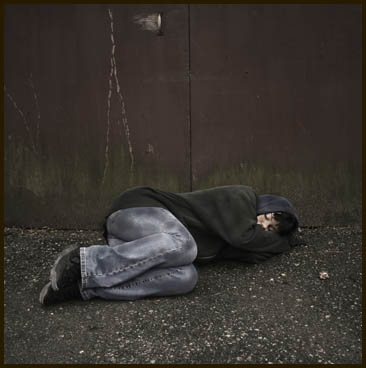
Meet Justin. Justin has a mother, father and brother who all live together in a decent house in the suburbs. Justin is homeless. Justin has been living on the streets for 2 years. Justin is 16.
Justin was raised in a seemingly normal family, in an ordinary neighborhood of single family homes just outside an urban center. Justin's father earned a modest, working-class living until he was laid off a few years back. Justin's father had always been partial to alcohol, and a short time after loosing his job his addiction consumed him. Soon, he could no longer hold a job, so Justin's mother became the breadwinner. During this time Justin's father developed into a pressure cooker of intense rage. Justin watched as his father beat his older brother on a regular basis. He was abusive to Justin as well - hardly a day went by without hearing that he was, "a useless piece of s--t!" and a "f-ing faggot!" As Justin emerged from puberty his abuse turned physical. Justin finally had enough and left home, at 14.
Justin found life in the streets was tolerable compared to where he had been. He found comfort in drugs. He stole things. He sold sexual favors for money. He spent his nights on sidewalks, alleys, abandoned buildings and seedy motels. He had a circle of friends - other homeless teens - who understood him. Life was good.
Now, Justin has just been arrested for the third time. His parents are called down to the police station. After a short discussion with the police, they are asked if they wish to terminate their parental rights. With Justin sitting right there, his father says, "You can have him."
• • • • • • • • • • • • •
Seattle Washington is a wealthy city. Home to successful companies such as Microsoft an Boeing, Seattle has enjoyed relative prosperity over the last several decades, more than most US cities. Yet sadly, each night over 1000 teenage children sleep on the streets of Seattle, with no place to call home.
Who are these kids? Drug addicts. Hooligans. Delinquents. Dropouts. Criminals. Prostitutes. These are the words that come to mind for most when the phrase "homeless teenager" is mentioned. The implication, and gross misconception, is that either these children are on the streets by choice, or that they somehow deserve this fate. Alone and on their own, some as young as twelve, the reality is that many, if not most, of these kids have been abandoned by their parents, tossed out like and old mattress.
Many of these kids come from a home where they suffered repeated abuse. Often, the parents of these children have severe problems with drugs and/or alcohol. Many of the kids come from broken families. Chronic unemployment is common in these households (naturally the harsh realities of the great recession are only exacerbating this problem). Whatever their particular personal and family pathology, they end up on the streets because living at home becomes intolerable. And once they are on the streets their prospects for a prosperous, productive future diminish rapidly. Once homelessness sets in, their future is cast in stone... almost.
Fortunately, some school districts take a very proactive approach to this problem, identifying at-risk kids and offering help and intervention early on. Some districts do not. But there is only so much a school can do. Once a child is without a permanent home, just getting to school every day can be an insurmountable challenge.
The foster system works for a lucky few, but the reality is that in most cases it just delays the onset of homelessness. Many foster parents are in it mostly for the money, and either way once the kids turn 18 the foster system drops them like lead.
There are organizations in many urban centers that offer help and services to homeless youth. While most of these organizations have been stretched thin by the effects of the recession and rapidly shrinking state and local budgets, they still offer the best chance for redemption. These programs can offer a range of services including meals, housing, education, counseling, life-skills and job training. But shrinking budgets have meant cutbacks in services, at a time when the number of kids needing help is growing.
Despite the rise of the indie filmmaker, and the abundance of social commentary films made in the last few decades, a few films have been made tackling this subject (the only documentary I am aware of was a very raw film made in the 1980's that can now only be found on Youtube). It is a subject that is inherently difficult to tackle on film. And there are no easy answers. The roots of the problem lie in much larger issues around poverty and the family unit. But because there is some hope for kids that end up on the streets (in the form of non-profit organizations that offer help), I believe that a film that raises awareness to this issue and dispels misconceptions - and thereby encourages compassion - is needed.
• • • • • • • • • • • • •
 SYNOPSIS:
“Flushed” will examine the issue of homeless youth through the eyes of the central characters of the film. These three characters will be between 18 to 23 years old, and currently homeless. As a filmmaker, I will be working closely with several organizations in the Seattle area that serve homeless youth. While the particular characters have not been identified yet (Justin is now an adult), I am confident that I will quickly find and establish a working relationship with the central characters of the film - homeless young men and women willing to share their diverse, and very personal stories.
Our characters will tell us about their past - their family life before they became homeless. They will discuss life on the streets, how they have survived. Their stories may be upsetting, graphic, abhorrent, and even frightening.
Our three characters will also reveal their hopes and dreams. Many kids in this situation strive to stay in school, as this can become a surrogate for home life. Our characters will talk about the help they have received from their schools and communities, and how this gives them hope for a prosperous future. One of the things anyone who works with homeless kids will tell you is how resilient they can be, our characters will demonstrate this resiliency. We will see that there is still a glimmer of hope in their eyes.
The power of documentary film is that it tells the story straight from the source. In a film of this nature there is a cost for this authenticity - the process subjects its characters' lives to intense public scrutiny. The central characters of "Wet Socks & Worn-out Sneakers" will be sharing especially revealing and personal information, and I am very concerned about the potential effects of airing this information. Accordingly, their identities will be withheld from the viewers, and I will employ actors to tell their stories - in their own, exact words (the actors' scripts will be directly transcribed from the original interviews, with specific names and places changed). I will conduct on-camera interviews with the three central characters, but these interviews will only be seen by my production team and they actors chosen to portray each character. While the use of actors will reduce the authenticity of the message somewhat, it will protect theses young individuals from any intrusion of privacy.
Additional characters in “Flushed” will be young adults (21 to 30 years of age) who were all homeless for some period of time in their teens, but are now employed or in school and looking at bright futures (these older characters, with a more positive message will appear on camera as themselves). One young man is attending college in the San Francisco Bay area. Another is a social worker and councilor at a youth shelter and homeless advocacy organization. Another (young woman) is a staff worker at a shelter and life-skills center for homeless teens. These characters will talk about making the transition from hopeless to hopeful and how the various organizations in their communities have helped turn their lives around. We'll also meet one family that considers helping street kids a calling, and has taken in over 100 kids over the last 20 years.
Other characters in “Flushed” will discuss the more general aspects of youth homelessness. One character will address the issues surrounding education. Another will address the legal aspects of child abandonment. Several will comment on the prospects facing the future of our characters, and discuss trends and statistics for the average homeless youth.
The narrative for “Flushed” will be carried mostly by the characters (not by the narrator). It is important that the message come straight from the youth, not from a pedantic narrator. If narration is used at all, it will be to tie together any loose fragments of the story.
Life on the streets takes its toll, even on resilient kids. Visually and aesthetically, “Flushed” will be a gritty film. Hand-holding a camera, when done properly, can give a film a more authentic, raw feel. I plan to use this technique when shooting b-roll or any time in the field, even for close-ups in two camera interviews. Much of the footage will be shot at night. We will begin production in winter, it will be cold and wet. The music for “Flushed” will mirror its look - raw and gritty (yet palatable to adult ears).
STATUS, TIMELINE and DISTRIBUTION:
“Flushed” is currently in preproduction. I will be working closely with several homeless advocacy and aid agencies to find and shoot our interviews. Their help will be instrumental in the success of the film. I have identified several potential supporting characters, but I expect to interview several more in the coming weeks. I expect to be finished with pre-production by January 2011, and in production immediately thereafter. I expect production to last through the spring of 2011. Postproduction should last another 12 -16 weeks. I hope the film to be finished by late fall, 2011.
I identify the core audience for this film to include primary and secondary school educators, students and educators in the field of sociology, social workers and people who work in social service agencies. Another core audience is fans of social commentary documentary. A broader, general audience will include teenagers, parents of teenagers, and other parents. While the core audience alone is probably enough to justify production of this film, I believe that the size and potential interest of the general audience makes production a necessity.
All profits from the distribution of “Flushed” will be donated to various service agencies in the Seattle, including Youth Care, Stand up for Kids, and Coffee Oasis.
Fundraising for this project is underway. For more information about this film, or for inquiries about donations, please CONTACT US.
©2010 Differential Films